


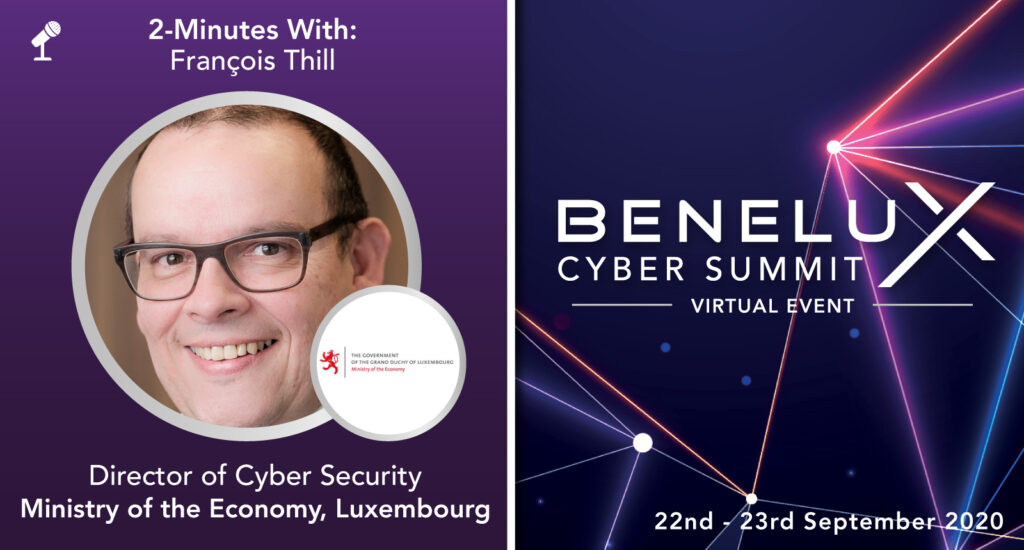
Ahead of the Benelux Virtual Cyber Security Summit, we sat down with François Thill, Director of Cyber Security at the Ministry of the Economy, Luxembourg for a quick discussion on the state of cyber security in Luxembourg today. With decades of experience in IT Security, François imparts his insights into how Luxembourg is approaching cyber security, the main challenges facing both the economy and security postures, and his views for the future.
Read on below for the full interview!
Please introduce yourself and tell us a little about your background….
My name is François Thill, I am Director cyber security at the Ministry of the Economy in Luxembourg. I have 20 years of experience in cyber security, represent Luxembourg at the board of ENISA and also have a good knowledge of privacy issues as I am a proxy member of the national data protection authority. My educative background is IT Engineer. I am 54 years old.
In a nutshell, what is Luxembourg prioritising at the moment in order to strengthen its cyber posture?
Luxembourg’s priorities lie on three pillars. First, we are working on reducing the complexity and price of cyber security for everyone (citizens, SME and corporates). To that end, we implement infrastructures that enable synergies, develop open-source tools, and provide guidelines in a language that also amateurs understand. A second priority is the intense fostering of collaboration. On the one hand, we promote the exchange of intel such as contextualised indicators of compromise between service providers, customers and the government. On the other hand, we also started to make the members of the Luxembourg cybersecurity ecosystem share services amongst themselves in order to be able to address large scale incidents. Our third and last priority builds upon the collective intel and consists of improving governance in cyber security both on a company and governmental level.
What are the 3 main cyber challenges to tackle in Luxembourg today? How is Luxembourg addressing these issues?
The main challenges we are facing are closely linked to our priorities:
1) Cybersecurity is still discriminatory in terms of complexity and price. We have been addressing this issue by providing tools and services for free, promoting the use of uncomplicated language, and by deploying large-scale training and security awareness campaigns for citizens and companies.
2) Cyber criminals continuously increase their capabilities with new technical developments. The number of potential victims increases rapidly due to the digitization of more and more business processes. Our cyber security ecosystem is mature, but its efficiency can be improved. The closer and more intense collaboration will address this issue – be it on the level of contextualised indicators of compromise, or by fostering the exchange of services that allow for better load balancing in large scale incidents.
3) Governance in cybersecurity is not optimally coordinated between regulators. Luxembourg addresses this issue by implementing “informed governance”, an approach based on situational awareness, the creation of basic and sectorial risk scenarios, and on guidance in risk management. This harmonisation of risk management will substantially reduce the weight of compliance, and improve overall governance.
What is your best piece of advice for businesses who are looking to move to Luxembourg?
My advice for companies moving to Luxembourg is to take advantage of or become part of our vibrant cyber security ecosystem. Cyber security is a strong factor of economic attractiveness, especially for companies that build their strength on IT. Cybersecurity is no longer an individual, but a collective challenge.
How are you encouraging synergies across local government, public sector and businesses?
We encourage synergies by providing open-source tools, free platforms and by motivating the members of the cyber security ecosystem to closely collaborate for the benefit of everybody. For more than 20 years, the Ministry of the Economy is considered as a trusted and neutral catalyst for cybersecurity in Luxembourg. For us, cyber security is a strong factor of economic attractiveness.
What does the future hold for cyber security in Luxembourg?
Luxembourg is deploying its data innovation strategy and implementing infrastructures for the data-driven economy. These new infrastructures and services need to be secured – an additional task for the Luxembourg cybersecurity ecosystem. We are proud of our capabilities and are always looking for new players that can enrich our ecosystem, providing innovative services.
Catch François at Benelux Cyber Summit on 22nd-23rd September for his Presentation: ‘Cybersecurity in Luxembourg – State of Play’! Join us for his session and enjoy live Q&As throughout the summit by registering for FREE online with code: BENELUXVIP at benelux.cyberseries.io.
